
Intermittent Bonded Ribbon Production Line For Sale
With a listed operating speed of 600 m/min, this machinery offers substantial capacity for optical-fiber production. Before making purchasing plans, buyers should verify the actual speed, configuration, and operating conditions with the manufacturer.
Shanghai Weiye OFC supplies equipment designed specifically for producing rollable ribbons containing 12 or 16 fibers. The published product information covers capabilities, technical details, and supplied systems, helping U.S. buyers begin evaluating the equipment against their manufacturing needs.
Begin by examining the stated equipment configuration, then ask the supplier for pricing, installation requirements, and project-specific alternatives. This approach helps determine which equipment details apply to your particular manufacturing site and goals.
The listed address for Shanghai Weiye Optic Fiber Communication Equipment Co., Ltd. is 201 Minyi Road, Songjiang District, Shanghai. Consider the product listing a preliminary information source, and confirm up-to-date specifications and commercial terms with the supplier. A detailed quotation request can help advance your equipment evaluation.
Fiber Coloring Machine
FTTH Cable Production Line
Fiber Draw Tower
Important Points To Consider
- A speed of 600 m/min is listed, but buyers should verify the operating conditions with the manufacturer.
- This equipment supports production of 12-fiber and 16-fiber rollable ribbon formats.
- Information about equipment functions, specifications, and included systems appears on the product page.
- Ask the supplier to clarify costs, installation arrangements, and requirements unique to your project.
- A company address in Shanghai’s Songjiang District is included in the supplier information.
Overview Of The Intermittent Bonded Ribbon Production Line
The manufacturer identifies this machinery as suitable for 12- and 16-fiber rollable IBR formats. Its product page specifies a construction speed of 600 m/min and a fiber diameter of Ф245 μm ±10 μm. Because these figures represent stated machine specifications, buyers should verify achievable speeds and operating conditions with the manufacturer.
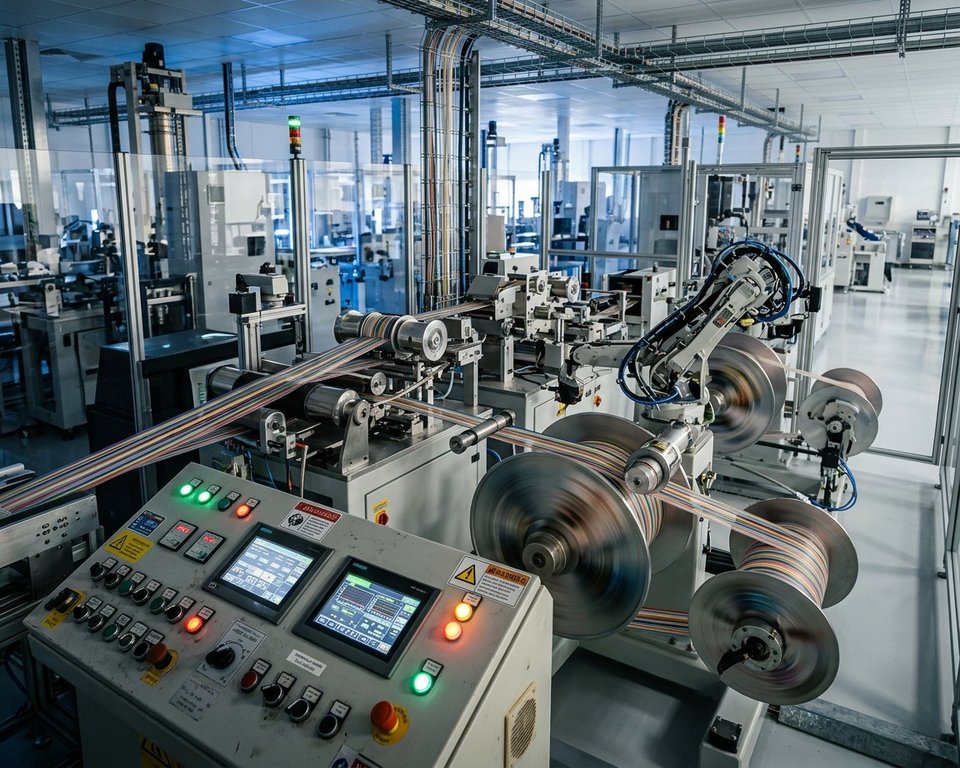 Intermittent Bonded Ribbon Production Line
Equipment Designed For Twelve- And Sixteen-Fiber Rollable Ribbon Production
The machine configuration accommodates two different fiber counts in rollable ribbon designs. Buyers can use these options as a starting point for checking compatibility with target formats, fiber sizes, and handling requirements.
How Intermittent Bonding Supports Flexible Fiber Arrangement
According to examples in the patent, fibers are arranged in adjacent subunits with adhesive connections applied periodically. The patent provides an example of adhesive-bond intervals ranging between 10 mm and 1,000 mm. Unlike continuous bonding, this arrangement does not join the fibers along their entire length.
By spacing the bonds apart, the assembly can move between a mostly planar arrangement and a rolled, curled, or folded shape. The specified spacing illustrates the patented design concept rather than confirmed production-machine settings.
- Machine details: 12 or 16 fibers, a stated speed of 600 m/min, and a diameter of Ф245 μm ±10 μm.
- Patent example: Adhesive-bond intervals ranging from 10 mm to 1,000 mm.
- Design benefit: Adaptable handling when the ribbon takes different shapes.
Applications In Optical Fiber Cable Manufacturing
Adjustable fiber layouts may allow cable designers to combine convenient splice access with space-efficient packaging. The patent outlines a configuration that maintains fiber organization while allowing portions to move between adhesive connection points during cable assembly.
Compact Cable Designs And High Fiber Density
An optical fiber ribbon may remain flat during mass fusion splicing and subsequently fold or roll for installation in a smaller cable. The patent identifies opportunities for reduced cable dimensions and a greater proportion of fiber area relative to the cable’s cross-sectional area. Actual performance and dimensions will vary according to the overall cable design and the application for which it is intended.
Ribbon Organization For Efficient Fusion Splicing
This design supports orderly fiber handling during splicing while providing flexibility for subunit movement in the assembly process. For production material planning, the listed specifications include payoff reels accommodating 25.2 km and 50.4 km of fiber. These reel capacities can be compared with the facility’s cable-manufacturing needs and material-handling setup.
| Design characteristic | Potential use | Buyer consideration |
|---|---|---|
| Planar fiber arrangement | Mass fusion splicing | Verify the needs of your splicing process |
| Folded or rolled format | Compact cable packaging | Review the overall cable construction |
| Payoff reels with capacities of 25.2 km and 50.4 km | Material-handling preparation | Align reel capacities with operating needs |
Production Line Specifications And Performance
Compare the equipment’s published performance figures with your manufacturing requirements before requesting a quotation. Reel compatibility and facility utility requirements are also important considerations for installation planning.
Production Speed, Fiber Diameter, And Attenuation
The stated construction speed is 600 m/min. The listed fiber diameter is Ф245 μm ±10 μm, with additional attenuation of ≤0.01 dB/km measured at 1550 nm. Confirm the measurement conditions and expected performance directly with the manufacturer.
Payoff And Take-Up Reel Compatibility
The payoff system accommodates two reel dimensions, and the maximum weight of a full reel is 10 kg. The take-up assembly supports a T-type reel as well as a fiber-optic reel. Verify that your selected reel configuration is compatible with the facility’s material-handling process.
Site Utilities And Environment
Plan for a 380 V ±10% power connection using a three-phase, five-wire system. The equipment should operate in an enclosed, clean, dry, draft-free area maintained at 15 to 25°C and a maximum relative humidity of 85%. Utility requirements also include nitrogen at 7 bar and 99.99% purity, plus a compressed-air supply at 6 bar. Verify the required utility connections before installation begins.
| Specification | Published requirement | Planning note |
|---|---|---|
| Payoff reels | Payoff dimensions of Ф236 × Ф25.4 × 108 mm or Ф267 × Ф25.4 × 180 mm; full reel ≤10 kg | Verify reel dimensions and weight |
| Reel used for take-up | T-type reel: Φ410 × Φ50.8 × 391 mm, alternatively a fiber-optic reel | Confirm compatibility with your selected format |
| Power and environment | Power supply of 380 V ±10%; temperature of 15 to 25°C; humidity ≤85% | Provide a clean, dry area without drafts |
| Gas utility supply | Nitrogen: 7 bar, 99.99% purity; air: 6 bar | Check available gas capacity before equipment setup |
Equipment For Fiber Payoff And Gathering
Optical fibers are guided toward the forming section by the payoff and gathering components. The associated controls help maintain a steady supply of fiber while reducing handling risks.
Tension-Controlled Payoff System For Sixteen Spools
The payoff assembly holds 16 spools and provides traversing along with separately adjustable tension settings. The permitted weight for an individual spool is up to 10 kg. Detailed specifications indicate a tension range of 0.4 to 2 N, accuracy of ±0.02 N, and a 550 W motor. Another overview gives a range of 40 to 150 g and accuracy of ±2 g, so buyers should confirm which specification applies to their configuration.
Fiber Guiding, Break Detection, And Electrostatic Control
The forming area receives fibers through U-groove guides, multi-groove gathering rollers, and devices designed to prevent jumping. Operators receive alerts about fiber problems through break detection and alarm functions. Safe handling is supported by protective guards and a pneumatic clamping mechanism. At the fiber exit, a rod-style electrostatic dust collector is installed, while anti-static equipment helps manage dust along the gathering route.
| Equipment component | Specified details | Intended function |
|---|---|---|
| Payoff | Capacity for 16 spools, each weighing up to 10 kg | Feeds optical fibers with traversing movement |
| Motor and tension system | Tension of 0.4 to 2 N, accuracy ±0.02 N; motor rated 550 W | Maintains controlled fiber payoff |
| Guidance and safety | Grooved rollers, alarms, guards, and pneumatic clamping | Directs fibers and supports safe handling |
| Electrostatic management | Rod-type dust collector and anti-static equipment | Helps reduce dust near fiber routes |
Intermittent Adhesive Dispensing And Precision Molding
The ribbon-forming platform allows operators to control the mold position and placement of adhesive. These settings allow the production process to be adapted to the intended ribbon configuration.
Ribbon Formation Using An Adjustable IBR Mold Platform
Ribbon formation uses three mold assemblies, each capable of holding up to five Nordson EFD jet valves. Operators can position the mold within 0 to 15 mm and adjust its base temperature from 20°C to 60°C. Grouped precision dispensing valves are installed on slide tables so operators can refine their alignment and place adhesive dots carefully.
Adjustable Nozzle Configurations For Twelve- And Sixteen-Fiber Ribbon Production
The 12-fiber configuration employs a 5+5+1 valve arrangement. Production of the 16-fiber format uses a 5+5+5 configuration. The control interface enables changes to dot count and spacing according to the ribbon configuration being manufactured. The process calls for a specialized adhesive suitable for both coating and curing.
| Process setting | 12-Fiber Format | 16-Fiber Format |
|---|---|---|
| Valve arrangement | 5+5+1 valve configuration | Valve arrangement of 5+5+5 |
| Mold adjustment | Adjustment range of 0 to 15 mm | 0 to 15 mm adjustment |
| Temperature of the mold base | Temperature range of 20°C to 60°C | 20°C to 60°C operating range |
UV-LED Curing For Bonded Fiber Ribbons
Adhesive across the fiber assembly is cured through a sequence of UV exposure stages. The arrangement of the ovens and their published operating values provide buyers with information for evaluating process compatibility.
Initial Pre-Curing And Main Curing Operations
Pre-curing is handled by three specialized 800 W LED-UV ovens. Each oven processes fibers supplied by a separate mold group before the material reaches the main 6 kW post-curing oven. Adjustable shutters reduce potential UV leakage and nitrogen loss. The supplier states a principal wavelength of 395 nm ±3 nm, minimum curing degree of 85%, and post-curing power of no less than 2.5 kW.
Nitrogen Management And Curing Performance
The nitrogen flow rate and pressure can be adjusted by hand. The system additionally switches nitrogen on when starting and off when shutting down. At production speed under continuous stable conditions, the specified lamp-array power consumption is no more than 80% of total power. The figures are useful for initial equipment assessment, but buyers should confirm the conditions under which they were measured. Ask whether different adhesives or materials require adjustments to the settings.
Visual Inspection, Capstan Traction, And Take-Up
Visual inspection and consistent winding help preserve fiber quality as material passes through the production line. Buyers can use the listed specifications to assess whether the machine meets the demands of their cable manufacturing process.
Online Inspection Of Fiber Color Sequence And Adhesive Dots
Real-time magnified views are displayed through the machine’s microscope and camera system. The display allows operators to check the sequence of fiber colors and confirm adhesive resin dots at each dispensing position. This inspection helps identify ribbon problems before the material enters the winding stage.
Servo-Driven Traction And Precision Take-Up
A 1 kW AC servo motor powers the capstan’s Φ190 mm traction wheel. Metering accuracy is specified as better than 1‰. The adjustable tension range is 50 to 500 g, with control accuracy of ±5 g. These operating parameters help maintain careful fiber-ribbon handling as the material advances through the line.
Take-up operation is rated at 600 m/min with a spool weight limit of 30 kg. Servo-controlled winding and traversing systems help maintain consistent material placement. The cable pitch setting allows continuous adjustment from 1 to 6 mm. Position detection and direction changes are supported by a photoelectric sensor. Check the intended cable requirements and actual operating conditions with the manufacturer.
Electrical Controls And Production Monitoring
Accessible controls allow operators to adjust settings, check equipment status, and arrange orderly shutdowns. The supplier identifies Siemens control equipment and Schneider Electric switchgear as components of the production line.
PLC And Touchscreen Operation
The ribbon production line uses Siemens S7-1200 and S7-1500 PLCs with a 10.4-inch Siemens touchscreen interface. Schneider Electric provides the low-voltage switching equipment. The system supports both interlocked operation across the full production line and separate operation of individual units.
Settings, Alarms, And Length-Based Stops
Through the touchscreen, operators can manage process settings, activate curing ovens, configure wire feeding, and view alarms. Additional displays provide lamp runtime, real-time current readings, curing-oven temperature, and total machine operating hours. The meter-counter calibration feature allows displayed counts to be aligned with the distance actually traveled.
A preset length can be entered to initiate slowing or stopping of the machine. This provides a practical way to control the end of a cable production run. Ask the manufacturer to confirm control capabilities and setup requirements before placing an order.
| Control-system feature | Published specification | Use |
|---|---|---|
| PLC and display | Siemens S7-1200/S7-1500; 10.4-inch touchscreen | Adjust and review operating information |
| Electrical control components | Schneider Electric low-voltage switchgear | Supports electrical control operations |
| Equipment monitoring and shutdown control | Operating data for lamps, ovens, runtime, and meters; preset-length function | Track operating conditions and initiate machine stopping or slowing |
Materials, Process Compatibility, And Ribbon Quality
The selected adhesive influences coating uniformity and the quality of the finished ribbon. Rather than recommending a general adhesive, the supplier specifies a formulation dedicated to the equipment’s coating and curing operations.
Dedicated Adhesive For Bonding And Curing
The pressure-fed adhesive system provides independent valve switches so each supply path can be opened or closed as required. Precision pressure-regulating valves help maintain controlled adhesive delivery at each dispensing location. The specified air pressure is adjustable, with a required minimum of 0.5 MPa.
The adhesive lines are black to reduce the risk of UV-triggered reactions while the system operates and cures material. Preventing unintended exposure matters because adhesive behavior could be affected before the material reaches the fiber surface.
Confirm suitable adhesives, process parameters, and surface-finish requirements with the manufacturer before choosing materials for a secondary coating operation. Discuss the material’s expected performance across your planned application and run duration. Clear process instructions can help maintain quality from initial setup through final production.
Installation Requirements And Included Documentation
Prepare the installation area and necessary utility connections before arranging equipment setup. The supplier’s specifications provide guidance for planning the production site and supporting consistent operation of the fiber-optic machinery.
Required Facility Conditions And Connections Provided By The Buyer
The machine should be positioned inside a draft-free, enclosed workspace that is clean and dry. Keep the operating area between 15 and 25°C, with humidity at or below 85%. The installation also requires nitrogen supplied at 7 bar with 99.99% purity and an air supply rated at 6 bar.
Connection cables and cable trays are excluded from the supplied equipment. The buyer must arrange the principal power feed-in cable. Verify the available utilities and planned cable routes ahead of setup, especially if a secondary coating section is nearby.
Documentation For Operation, Installation, And Maintenance
Documents covering installation, equipment use, and maintenance are provided by the manufacturer. Inspect the supplied documentation before commissioning so personnel can organize tasks and obtain required materials.
- Instruction manuals, operating guides, and a general layout drawing
- Wiring and electrical schematic diagrams, plus installation and maintenance drawings
- Manuals for purchased parts and a list of wear parts for maintenance planning
These documents help maintenance and production teams prepare for initial startup and regular equipment care.
Choosing A Ribbon Production Line For Your Manufacturing Needs
Begin by identifying the ribbon formats you intend to manufacture and sell. This production line is designed for 12F and 16F options, with a listed construction rate of 600 m/min. Compare those specifications with your expected product mix, production targets, and anticipated cable demand.
Before purchasing the machine, confirm that its take-up arrangement matches your requirements. A standard IBR reel measures Φ410 × Φ50.8 × 390 × Φ310 mm, accommodates a maximum weight of 30 kg, and allows cable pitch settings between 1 and 6 mm. Check that these specifications suit your production facility and material-handling operations.
Payoff reel compatibility also deserves attention. Available options include international-standard spools accommodating 25.2 km, 50.4 km, and 63 km. Request precise reel measurements before selecting materials or determining production run lengths.
In addition to speed, consider power and gas utilities, suitable adhesives, and the available monitoring functions. Assess whether the equipment arrangement is appropriate for fiber cable, loose tube, or the specific application in your cable production process. Before ordering, review equipment configuration and startup requirements directly with Shanghai Weiye. A thorough compatibility assessment can help prevent expensive modifications later.
| Planning point | Listed detail | Buyer check |
|---|---|---|
| Formats and speed | 12F, 16F; specified speed of 600 m/min | Match the specifications to manufacturing goals and product range |
| Take-up | 30 kg maximum capacity; adjustable pitch from 1 to 6 mm | Verify that the reel and site arrangements are suitable |
| Fiber payoff reel options | 25.2 km, 50.4 km, and 63 km spool capacities | Verify exact spool dimensions |
Request A Quote For The Intermittent Bonded Ribbon Production Line
U.S. buyers can evaluate a system offering 12F and 16F formats, a specified construction rate of 600 m/min, and specialized optical fiber ribbon-forming equipment. Compare these features with your planned cable products to assess equipment suitability.
When requesting a quotation, provide the required ribbon format, expected output volume, preferred reels, and available site utilities. Also describe the fiber type and handling requirements so Shanghai Weiye can evaluate the proposed configuration.
Confirm the suitability of the adhesive, the LED wavelength specification of 395 nm ±3 nm, and expected curing results before purchasing. Ask the supplier how these parameters relate to the chosen materials and required surface quality.
Consult the product page for the published equipment description. Contact Shanghai Weiye Optic Fiber Communication Equipment Co., Ltd. to confirm machine configuration, delivery arrangements, and commissioning requirements. The company’s listed address is 201 Minyi Road, Songjiang District, Shanghai. Telephone 021-60701630 to discuss your manufacturing requirements. Providing complete information in your quote request makes the following stages easier to clarify.